Splunk vs Sentinel vs Elastic: Connector Packaging and Certification Compared
When teams compare SIEM platforms, they often focus on detection capabilities, search performance, pricing, or the number of available integrations.
But there is another question that becomes increasingly important after deployment:
How are those integrations packaged, supported, and maintained?
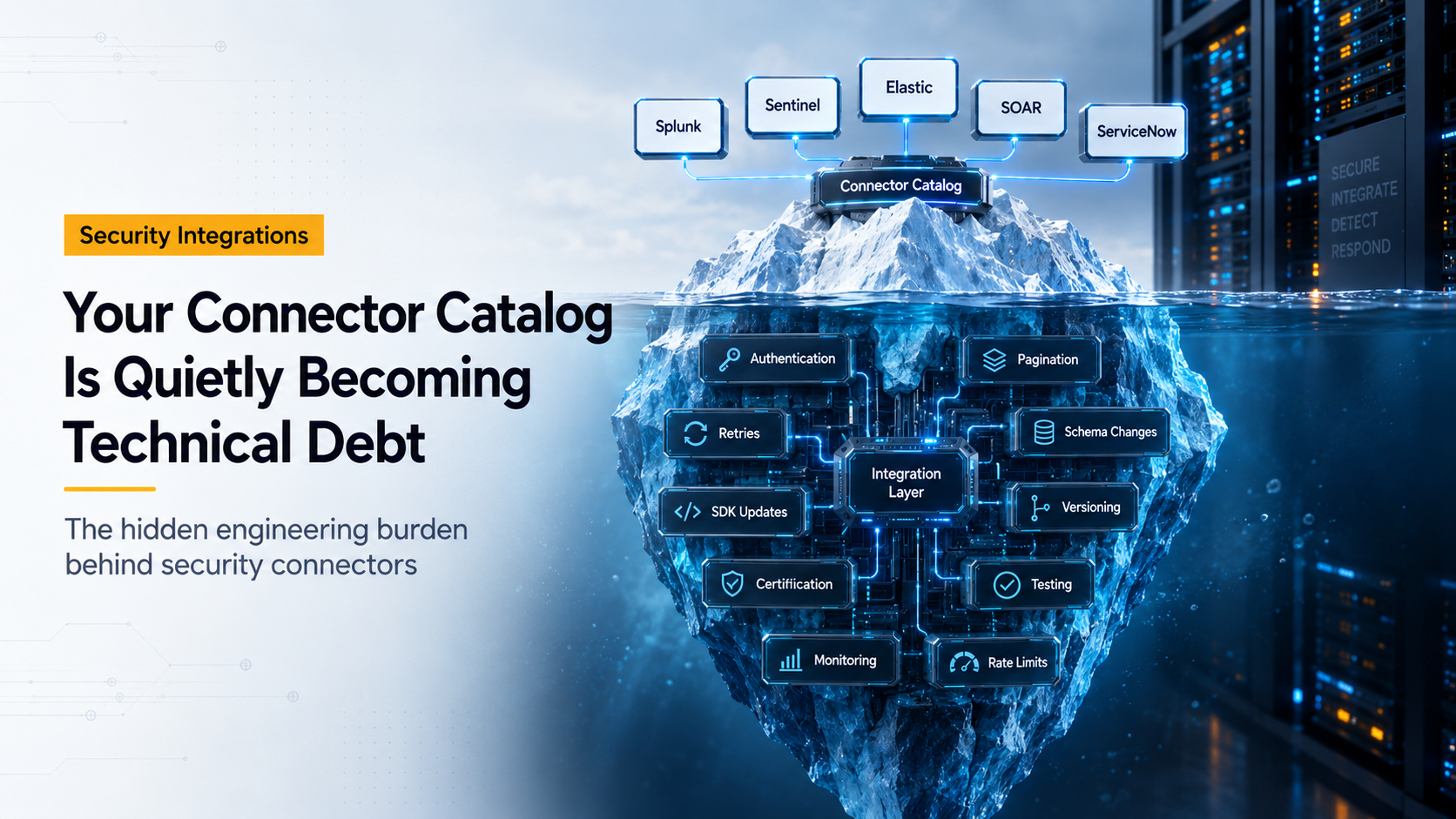
A connector may work today, but APIs change, authentication methods evolve, schemas drift, and SIEM platforms introduce new requirements.
That makes connector packaging and ownership an important part of long-term SIEM operations.
Microsoft Sentinel, Splunk, and Elastic all provide mature integration ecosystems, but they approach connectors differently.
A Connector Is More Than Data Ingestion
At its simplest, a connector moves data from a security product into a SIEM.
This can happen through REST APIs, Syslog, CEF, agents, forwarders, webhooks, or other mechanisms.
But getting data into the platform is only the beginning.
The SIEM must also understand that data.
This means parsing fields correctly, handling timestamps, identifying users and hosts, and mapping events into a common schema.
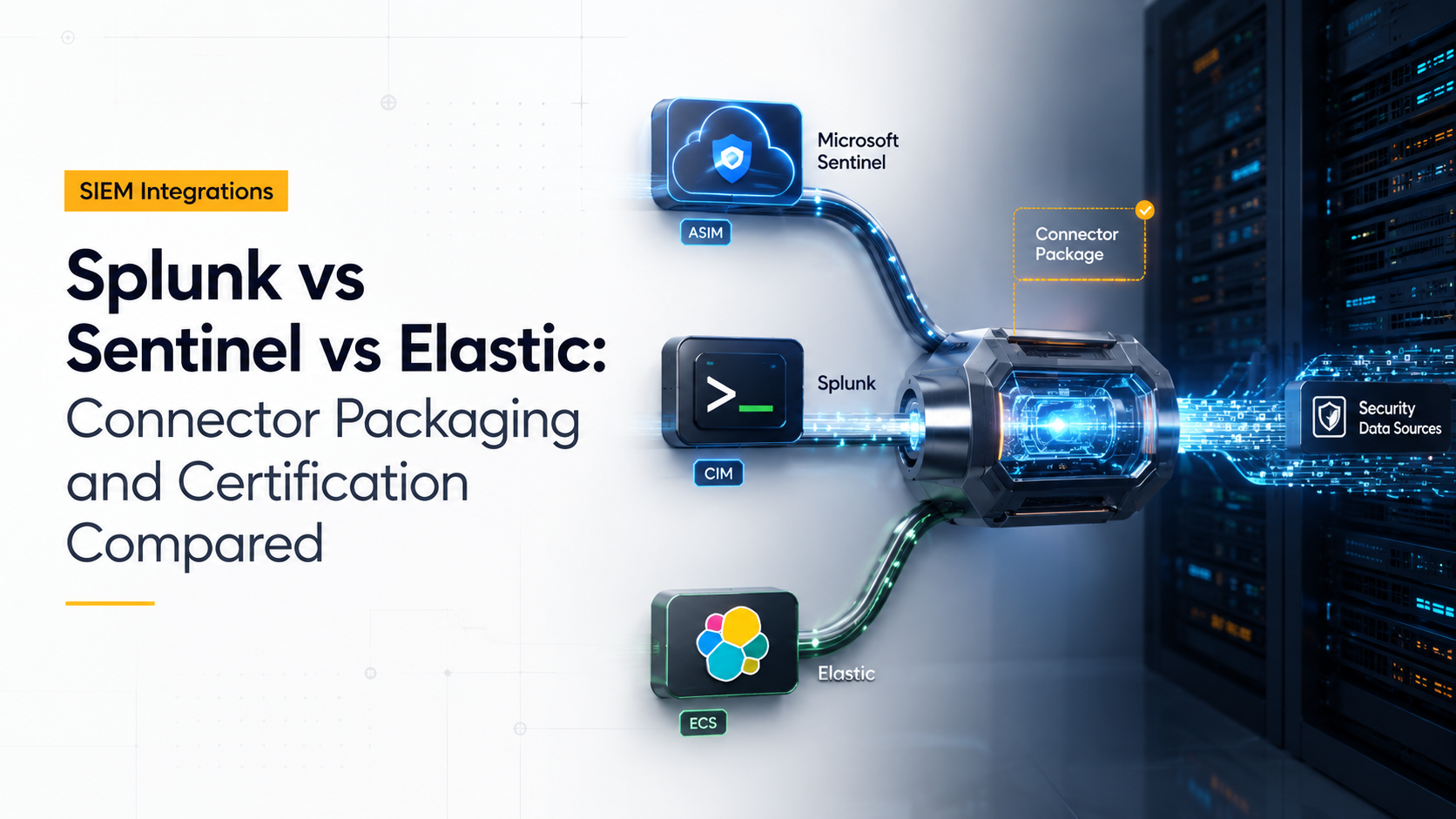
Each platform has its own normalization approach:
Microsoft Sentinel: ASIM
Splunk: CIM
Elastic: ECS
Without normalization, analysts may have to write different queries for every vendor. With a common schema, detections and investigations can operate more consistently across multiple data sources.
Packaging Changes the Operational Experience
SIEM connectors are not always delivered as standalone ingestion components.
A connector package may also include:
Parsers
Dashboards
Detection rules
Hunting queries
Visualizations
Alert templates
Automation content
Documentation
This is where Sentinel, Splunk, and Elastic begin to differ.
Some ecosystems are more solution-oriented, while others give engineering teams more modular control.
Microsoft Sentinel: Solution-Oriented Packaging
Microsoft Sentinel uses a relatively solution-centric approach.
Through Sentinel solutions and Content Hub, organizations can deploy integrations together with supporting security content such as analytics rules, workbooks, parsers, hunting queries, and playbooks.
For new partner-developed connectors, Microsoft's Codeless Connector Framework (CCF) has become particularly important.
Microsoft's current solution guidelines require partners to use CCF for new data connectors instead of Azure Functions unless an exception is needed. CCF manages the connector's polling infrastructure, scaling, and health monitoring without requiring customers to deploy a separate service.
For organizations, this can reduce infrastructure management around API-based connectors.
For technology vendors, however, it means integrations need to follow Microsoft's publishing and connector-development requirements.
Sentinel is a strong fit when:
You want cloud-native connector management
You prefer packaged security content
Your environment is heavily Microsoft-oriented
You want to minimize customer-managed connector infrastructure
Splunk: Modular and Flexible
Splunk traditionally takes a more modular approach.
A Technology Add-on (TA) may handle data collection, source types, field extraction, and normalization, while another Splunk application provides dashboards, searches, reports, or security content.
This gives engineering teams significant flexibility.
For example, an organization can use a TA for ingestion while developing its own dashboards and detections.
Normalization commonly revolves around Splunk's Common Information Model (CIM). Mapping fields correctly to CIM can make the same detection logic work across multiple technologies.
Ownership is another important consideration.
Splunkbase currently differentiates applications into Splunk-built, Cisco-built, partner-built, and community tiers. Splunk-built applications are developed and maintained by Splunk teams, while partner and community applications have different support and ownership models.
So finding a connector on Splunkbase should not automatically end the evaluation.
Teams should also ask:
Who maintains it?
Is it CIM-compatible?
When was it last updated?
Which Splunk versions are supported?
What happens when the source API changes?
Splunk is a strong fit when:
You need extensive customization
Your environment contains many different technologies
Your team wants granular control over ingestion
You have engineering resources for managing integrations
Elastic: Integration Packages Built Around ECS
Elastic provides integrations as packages that can contain both data collection configuration and supporting assets.
Elastic Agent integrations can include ingestion and transformation rules, configuration options, dashboards, visualizations, documentation, and, in some cases, alert templates. Many are based on the Elastic Common Schema (ECS).
Elastic Agent and Fleet provide centralized management for deploying and updating integrations and agent policies.
ECS plays an important role in the model.
Instead of every integration creating completely unrelated field structures, ECS provides common field definitions for concepts such as users, hosts, IP addresses, processes, networks, and events.
That can make cross-source searching and detection easier.
Elastic is a strong fit when:
You value schema-driven data architecture
You combine security and observability data
You need flexible ingest pipelines
You want centralized agent and integration management
Certification Is Really About Ownership
When evaluating integrations, the word certified should not be treated simply as a marketplace badge.
The operational question is:
Who is responsible when the integration breaks?
An integration may generally be:
Platform-maintained: Developed and supported by the SIEM vendor.
Partner-maintained: Developed by a technology vendor or approved partner.
Community-maintained: Developed by external contributors with potentially different support expectations.
All three models can provide useful integrations.
The difference becomes important when an upstream vendor changes an API, introduces OAuth changes, modifies pagination, or changes the structure of returned events.
Without clear maintenance ownership, a connector can quickly become technical debt.
What Security Teams Should Evaluate
Instead of comparing SIEMs based only on connector counts, evaluate each important integration across four areas.
1. Data Collection
How does the connector retrieve data?
API, agent, Syslog, webhook, or additional middleware?
2. Normalization
Does it properly map data into ASIM, CIM, ECS, or another common structure?
3. Packaged Content
Does the integration include detections, dashboards, parsers, alerts, or other immediately usable content?
4. Maintenance
Who updates the connector when the source product or SIEM platform changes?
This final question is often the most important over the long term.
There Is No Universal Winner
Sentinel, Splunk, and Elastic each provide capable integration ecosystems.
The difference is largely in how those ecosystems are structured.
Sentinel leans toward cloud-managed, solution-oriented integration.
Splunk provides extensive modularity and customization.
Elastic combines package-based integrations with ECS and centralized Fleet management.
The better question is therefore not:
"Which SIEM has more connectors?"
It is:
"Which connector model fits the way our security and engineering teams operate?"
For vendors building integrations, the same principle applies.
Getting logs into a SIEM is only the first step. A production-ready connector also needs reliable parsing, schema mapping, scalable ingestion, documentation, packaging, and a clear maintenance path.
ForshTec Systems helps security technology vendors build and maintain integrations across Microsoft Sentinel, Splunk, Elastic, SIEM, SOAR, XDR, and other cybersecurity ecosystems, helping turn raw product data into integrations that security teams can actually use and maintain.
About the author
- A cybersecurity enthusiast, an engineer at core, a student for life, an ambitious entrepreneur. I am a seasoned professional with a proven track record in cybersecurity, where I've played a pivotal role in developing niche expertise for large-scale teams. Headed engineering team of 200+ delivering cybersecurity solutions for partners ranging from Fortune 100 to the early stage startups. Experience in setting up engineering practices for niche and nuanced technology frameworks synergising people, processes and technology.
Comments
Join the discussionNo comments yet. Be the first to comment.