MCP Connectors Are Becoming Agent Interfaces: What Security Teams Need to Know
For years, software integrations followed a familiar pattern.
One system generated data. A connector moved that data somewhere else. Another platform processed it.
That model works well for traditional security integrations, such as sending alerts from an EDR platform to a SIEM or triggering a SOAR playbook from a security event.
AI agents are changing that model.
An AI agent does not always need a continuous stream of raw data. Sometimes, it simply needs to ask:
“What critical vulnerabilities are open right now?”
Or:
“Show me the incidents associated with this user.”
Or even:
“Isolate this endpoint after I receive approval.”
This changes what we expect from a connector.
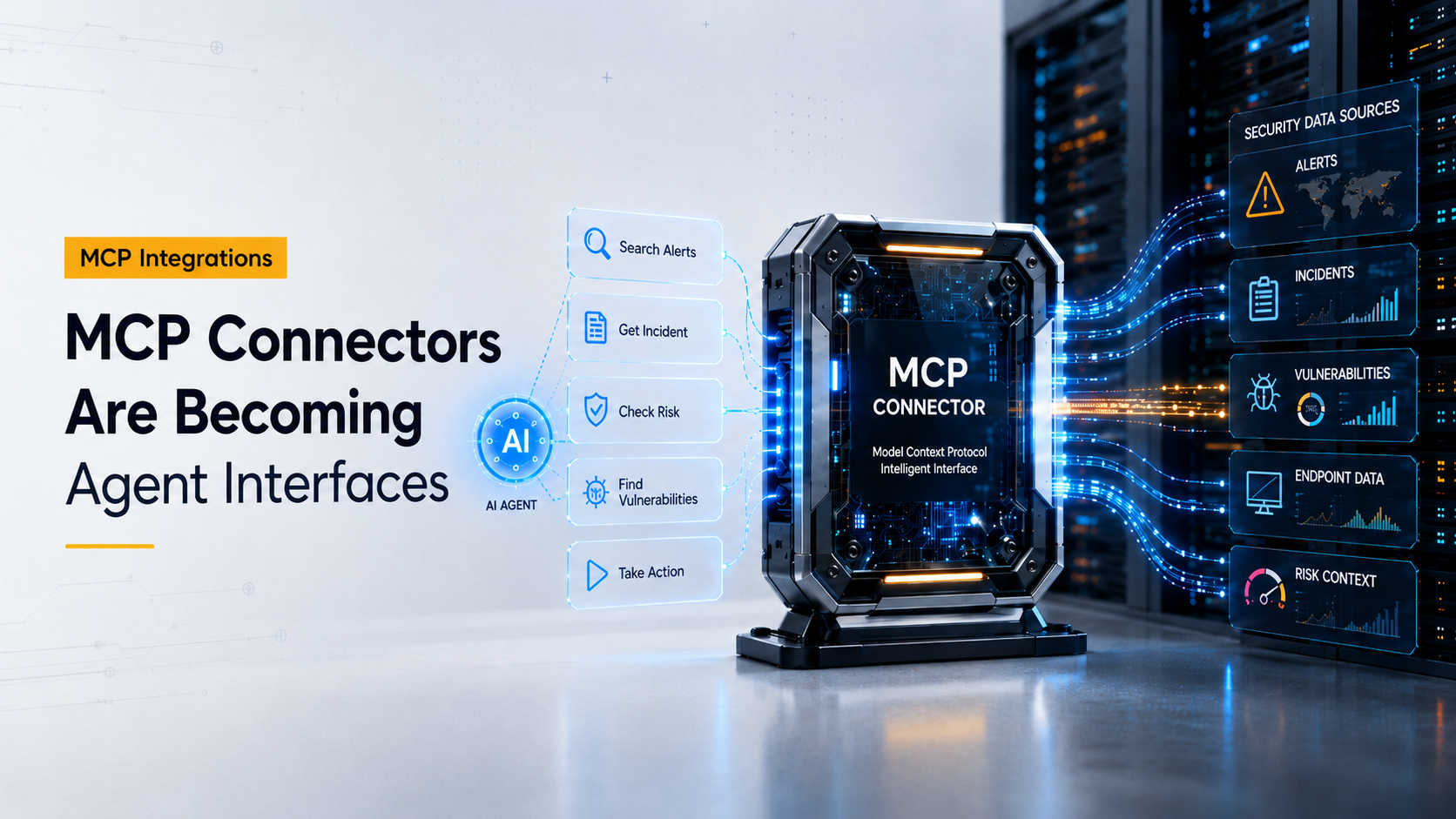
Instead of acting only as a data pipe, the connector starts becoming an intelligent interface between the agent and the security platform.
This shift toward connector intelligence is one of the reasons Model Context Protocol, or MCP, is becoming increasingly relevant.
What Is MCP in Simple Terms?
Model Context Protocol provides a standardized way for AI applications and agents to interact with external tools, systems, and data.
Think about a traditional API integration.
A developer normally needs to understand:
API endpoints
Authentication
Request formats
Parameters
Response schemas
Error handling
The application then needs custom logic to work with that API.
MCP adds a standardized interface between the AI system and those capabilities.
Instead of expecting an AI agent to understand every underlying API, an MCP server can expose clear tools that the agent can discover and use.
For example, a security platform could expose tools such as:
get_incident
search_alerts
find_vulnerabilities
get_asset_risk
create_ticket
isolate_endpoint
The AI agent can select the appropriate tool according to what the user wants to accomplish.
Traditional Connector vs MCP Connector
The difference becomes easier to understand with an example.
Imagine a vulnerability management platform.
A traditional connector might continuously pull vulnerability findings and send them into a SIEM.
The basic flow looks like this:
Security Product → Connector → SIEM
The connector's main responsibility is moving and transforming data.
An MCP-enabled interface works differently.
An AI agent might ask the vulnerability platform:
“Which internet-facing assets have critical vulnerabilities?”
The MCP server provides the tools required to answer that specific request.
The flow becomes:
AI Agent → MCP Interface → Security Product → Relevant Response
The important difference is intent.
Traditional connectors generally move predefined data.
Agent interfaces allow an AI system to request the information or action it needs for a particular task.
The Connector Is Becoming an Interface
This represents a major change for security product companies.
Historically, building an integration meant answering questions such as:
Which API should we call?
How often should we poll it?
Which fields should we collect?
How should we normalize the data?
Where should we send it?
Those questions still matter.
But agent-driven integrations introduce another layer.
Teams now also need to ask:
What should an AI agent be allowed to discover?
Which actions should it perform?
How should tools be described?
What context does the agent need?
Which operations require approval?
What permissions should each tool receive?
The connector is no longer simply translating data.
It is presenting the capabilities of a security product to an AI agent.
That means the way connectors are designed may become just as important as the APIs behind them.
Good APIs Do Not Automatically Create Good Agent Interfaces
A security vendor may already have a powerful REST API.
That is a strong foundation.
But exposing every API endpoint directly to an AI agent may not create a good experience.
Imagine a product with 200 API endpoints.
Technically, an MCP server could expose hundreds of tools corresponding to those endpoints.
But should it?
Probably not.
Agents work better when available capabilities are clear and meaningful.
Instead of exposing several low-level API operations, the MCP interface might provide one task-oriented tool:
Get high-risk assets
Behind that tool, the connector could:
Query assets
Retrieve vulnerability data
Apply risk filters
Normalize the results
Return useful context
The complexity stays behind the interface.
The agent receives information it can actually understand and use.
This Is Where Connector Intelligence Matters
Building an MCP interface should not simply mean converting REST endpoints into tools.
A better question is:
What does an AI agent actually need from this product?
That requires understanding both the technology and the security use case.
For a SIEM platform, useful agent capabilities might include:
Search security events
Retrieve incident details
Find related alerts
Investigate an entity
Check detection status
For an EDR platform, they could include:
Retrieve endpoint information
Check endpoint risk
Find recent detections
Start an approved investigation
Isolate a compromised device
For a threat intelligence platform:
Look up an indicator
Retrieve reputation
Find related campaigns
Enrich an IP, domain, or file hash
These are not simply API mappings.
They are security capabilities presented in a way an agent can understand.
Designing that layer requires many of the same engineering principles already used in professional security connector development, including authentication, API handling, normalization, reliability, permissions, and lifecycle maintenance.
Read Access and Action Are Very Different
Security becomes especially important when MCP tools can perform actions.
There is a major difference between:
“Show me information about this endpoint.”
and:
“Isolate this endpoint.”
The first retrieves information.
The second changes the environment.
An enterprise MCP implementation therefore needs to consider:
Authentication
Authorization
Least-privilege access
User identity
Tool permissions
Audit logging
Approval workflows
Credential management
This becomes even more important when an AI agent can take actions across multiple security platforms.
An agent should not receive broader permissions simply because it can access a tool.
Every capability needs appropriate controls around it.
MCP Does Not Replace Traditional Integrations
MCP should also not be viewed as a replacement for every existing connector.
A SIEM may still need continuous ingestion of millions of security events.
That is a good use case for a traditional connector.
At the same time, an AI assistant may need to query the same product for specific information.
That is a good use case for an MCP interface.
Both can exist together.
Traditional connector: moves telemetry continuously.
MCP interface: provides agents with contextual access to information and capabilities.
Future security products may therefore need multiple integration interfaces serving different purposes.
What Security Vendors Should Start Thinking About
Security vendors preparing for agent-driven ecosystems should look beyond one simple question:
“Do we support MCP?”
Instead, teams should ask:
Which product capabilities should agents access?
Which capabilities should remain read-only?
Which actions require human approval?
How should tools be named and described?
What context should each tool return?
How will agent activity be logged?
How will authentication work?
Who maintains the interface when APIs change?
These decisions determine whether an MCP implementation becomes genuinely useful or simply another technical checkbox.
From Connector Development to Agent Interface Engineering
Security integrations are entering a new phase.
Traditional connector engineering focuses heavily on APIs, ingestion, transformation, normalization, authentication, and workflow automation.
Those skills remain important.
But AI agents introduce another requirement:
Designing interfaces that machines can understand and safely operate.
That means modern integrations increasingly need to combine:
API engineering + security knowledge + connector architecture + agent interface design
For security vendors, this creates a significant opportunity.
A well-designed MCP interface can make product intelligence accessible through AI assistants, automated workflows, developer environments, and emerging agent ecosystems.
But simply exposing an existing API through MCP is not enough.
The real value comes from deciding what capabilities should be exposed, how they should be structured, and how AI agents can use them safely.
That is the next evolution of connector engineering.
ForshTec Systems works with security vendors, ISVs, MSSPs, and technology companies to engineer integrations and connectors across modern cybersecurity ecosystems, from traditional SIEM, SOAR, and XDR integrations to the emerging agent-driven interfaces shaping the next generation of security products.