How Security Leaders Can Reduce SIEM Ingestion Costs Without Losing Visibility

For years, security teams have followed a simple rule: collect as much security data as possible and send it to the SIEM.
It made sense when enterprise environments were smaller. Today, organizations generate enormous volumes of telemetry across endpoints, cloud platforms, identity systems, SaaS applications, networks, and security tools.
The problem is that more data does not automatically mean better security.
In many environments, a significant portion of ingested telemetry provides limited value for real-time detection but still contributes to SIEM ingestion, processing, indexing, and storage costs.
For CISOs and security leaders, the challenge is no longer simply collecting more data. It is deciding which data deserves expensive SIEM capacity and which data can be filtered, routed, or stored elsewhere.
The Hidden Cost of "Ingest Everything"
Traditional SIEM architectures often follow this model:
Collect → Transform → Index → Store → Analyze
Every additional event can increase infrastructure consumption.
Consider telemetry from an endpoint security platform. An organization may generate millions of events every day, including detections, authentication activity, system events, network connections, informational messages, and repetitive records.
Sending all of this directly to the SIEM can create unnecessary costs.
The problem becomes even more significant when multiple security platforms generate overlapping data.
Instead of asking, "What logs can we stop collecting?", security leaders should ask:
"What data actually needs to be in the SIEM?"
That change in thinking is critical.
Filter Data Before It Reaches the SIEM
One of the most effective ways to reduce SIEM costs is to make decisions before ingestion.
An intelligent integration layer can evaluate telemetry at the source and apply routing policies based on factors such as:
Event severity
Security relevance
Source
Frequency
Duplication
Retention requirements
Detection use cases
High-value events can be sent directly to the SIEM, while lower-value or high-volume telemetry can be filtered, aggregated, or routed to lower-cost storage.
For example:
Critical security alerts → SIEM
Authentication anomalies → SIEM
Routine endpoint events → Selective routing
Historical telemetry → Object storage
Duplicate or low-value events → Suppression
This approach does not mean losing visibility. It means putting data in the right place for its purpose.
Don't Turn the SIEM Into a Data Lake
Another common architectural problem is using the SIEM as the organization's universal security data repository.
SIEM platforms are valuable for detection, correlation, investigation, and security analytics. But storing every raw event in expensive hot storage may not be the most efficient architecture.
A modern Security Data Fabric architecture separates data storage from analytics. Instead of forcing every event into one centralized platform, organizations can keep data across cloud object storage, data lakes, endpoint platforms, and other native systems while maintaining access through federated queries and intelligent routing.
This approach can reduce the need to maintain multiple expensive copies of the same security data while still giving analysts access to the information they need.
For a deeper look at how Integration Engineering supports this architecture, see ForshTec's guide on Security Data Fabric and Integration Engineering.
The result is a more flexible architecture:
Data stays where it makes economic and operational sense.
The SIEM receives the data required for security operations.
Integration Engineering Matters
Reducing SIEM costs is not just a matter of installing a filtering tool.
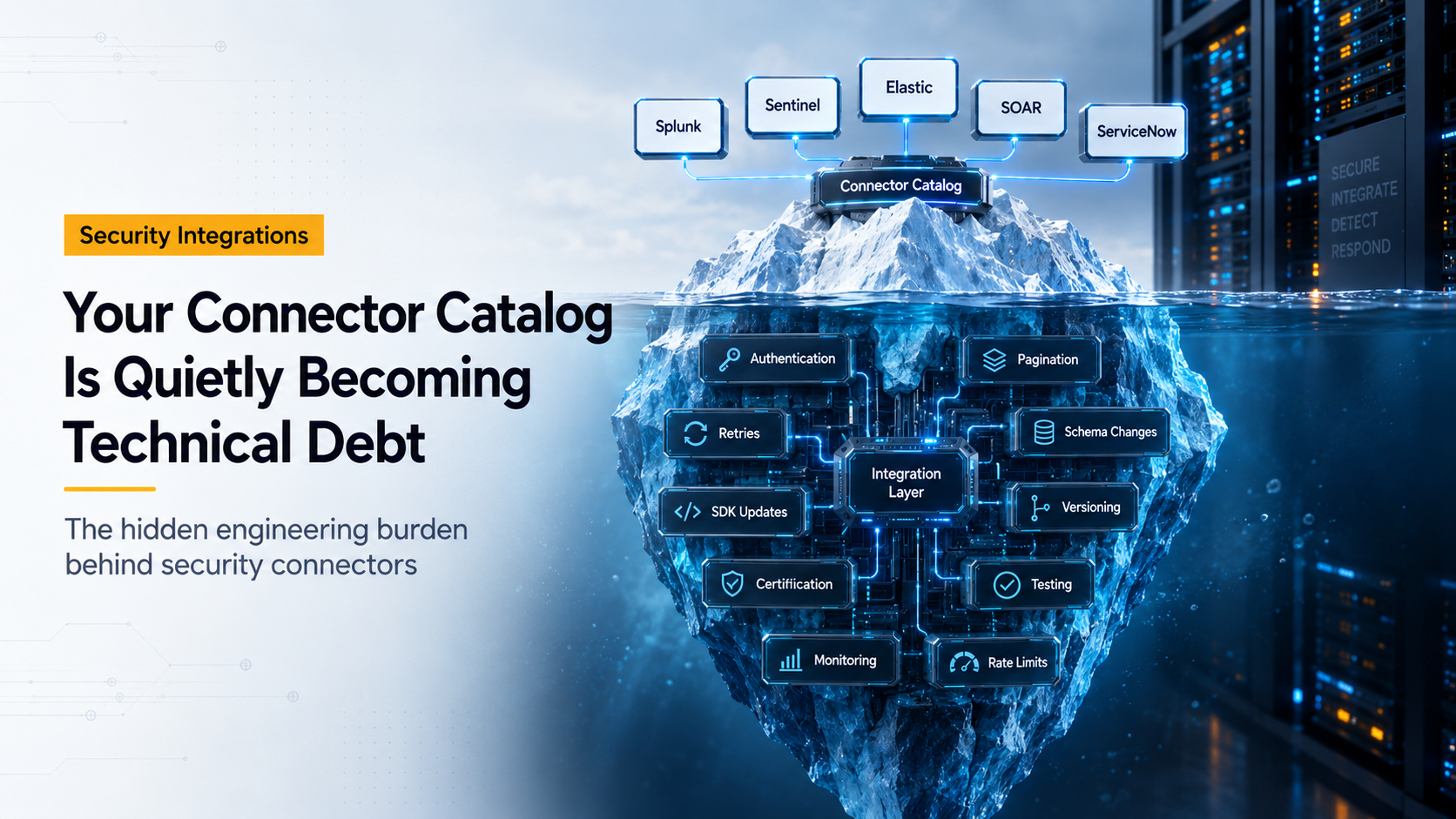
Modern security environments depend on dozens or hundreds of integrations, each with different APIs, schemas, rate limits, and event formats.
A resilient integration layer needs to handle:
API rate limiting
Schema changes
Duplicate events
Retry logic
Data enrichment
High event volumes
Pipeline failures
Standardized security schemas such as the Open Cybersecurity Schema Framework (OCSF) can also help organizations normalize data across different vendors and reduce long-term integration complexity.
This becomes particularly important when organizations want to avoid becoming overly dependent on a single security platform.
A Better Way to Think About SIEM Costs
Security leaders should measure SIEM optimization using more than ingestion volume.
Important metrics include:
SIEM ingestion volume
Cost per GB
Percentage of telemetry filtered before ingestion
Duplicate event reduction
Detection coverage
Data pipeline failures
Investigation performance
The objective should be:
Lower SIEM costs without sacrificing detection capability.
Simply sending less data to the SIEM is not a successful strategy if it creates security blind spots.
The Strategic Shift
The future of SIEM architecture is unlikely to be based on collecting every possible event.
Instead, security teams will increasingly focus on intelligent data placement.
High-value telemetry should receive the expensive processing and analytics it deserves. Other data can be filtered, aggregated, retained in lower-cost storage, or accessed through a federated architecture when needed.
For CISOs, this creates an important opportunity.
SIEM optimization is not merely a licensing exercise. It is an architecture problem.
By combining intelligent ingestion, data routing, standardized schemas, and resilient Integration Engineering, organizations can reduce unnecessary SIEM consumption while maintaining the security visibility their analysts depend on.
The key question is no longer:
"How much security data are we collecting?"
It is:
"How much of that data actually needs to be in the SIEM?"
That is where meaningful SIEM cost optimization begins.
How ForshTec Helps
ForshTec helps organizations engineer integrations and security data workflows across complex security ecosystems. Its capabilities include security connector development, data normalization, intelligent routing, and resilient integrations designed for enterprise-scale environments.
For organizations looking to reduce unnecessary SIEM ingestion while maintaining security visibility, a smarter integration architecture can provide a practical path toward a more efficient Security Data Fabric.
About the author
- A cybersecurity enthusiast, an engineer at core, a student for life, an ambitious entrepreneur. I am a seasoned professional with a proven track record in cybersecurity, where I've played a pivotal role in developing niche expertise for large-scale teams. Headed engineering team of 200+ delivering cybersecurity solutions for partners ranging from Fortune 100 to the early stage startups. Experience in setting up engineering practices for niche and nuanced technology frameworks synergising people, processes and technology.
Comments
Join the discussionNo comments yet. Be the first to comment.